AHDI Career Resource
Helping healthcare documentation professionals recognize the value of their skills—and discover where those skills can take them next.
From Medical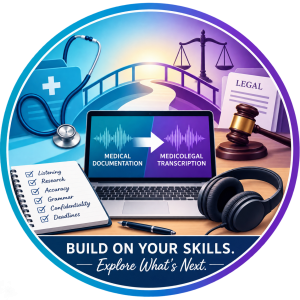 Transcription/Healthcare Documentation to Medicolegal Transcription
Build on the skills you already have. Explore a new career path.
If you’ve built your career in medical transcription, editing, scribing, or another healthcare documentation profession, you already have many of the skills that can transfer to legal transcription.
Medical and legal transcription share many foundational skills, including careful listening, accuracy, attention to detail, research, grammar and punctuation, confidentiality, independent work, and meeting deadlines.
With additional training in legal terminology, procedures, formatting, and verbatim transcription, your existing expertise can become the foundation for a new professional direction.
Your Skills Are Transferable
You don’t have to start over. You can build on your experience. You already have the foundation.
A career in healthcare documentation develops skills that are valuable beyond the medical environment.
You may already be experienced in:
Listening & Accuracy: Listening carefully, recognizing speakers, and producing accurate documentation.
Research & Terminology: Researching unfamiliar words, medical terminology, names, and concepts rather than guessing.
Grammar & Editing: Applying strong grammar, punctuation, spelling, and editing skills.
Attention to Detail: Identifying errors and inconsistencies while maintaining a high level of accuracy.
Confidentiality: Working responsibly with sensitive and confidential information.
Independent Work: Managing your workload, productivity, and deadlines with minimal supervision.
Professional Standards: Following client requirements, style guides, and quality expectations.
These competencies provide a strong foundation for entering legal transcription.
From Medical to Legal: What Changes?
The foundation is familiar. The rules are different.
Moving into legal transcription doesn’t mean learning transcription from the beginning. It means learning how those skills are applied in a different environment.
| Medical Transcription | Medicolegal Transcription |
| Provider dictation | Depositions, hearings, proceedings, and other legal audio |
| Often structured dictation | Often unstructured conversation |
| Editing may improve readability | Verbatim capture is essential |
| Medical terminology | Legal terminology and subject-specific language |
| Platform-based documentation | Word processing, templates, indexes, title pages, and pagination |
| Healthcare-specific style requirements | Court-, client-, and jurisdiction-specific requirements |
| Clinical record | Legal record |
Legal proceedings can involve interruptions, false starts, overlapping speech, multiple speakers, and long, conversational sentences. Legal transcription requires accurately capturing what was said verbatim while making the transcript readable through appropriate punctuation and formatting.
The transition is absolutely achievable, but understanding these differences is critical to preparing for success.
What Will You Need to Learn?
Transitioning to legal transcription requires more than simply changing the terminology.
Key areas of learning include:
Legal Terminology & Procedures: Develop familiarity with legal language, proceedings, and the terminology used in different types of cases.
Legal Research & Case Law: Develop the ability to thoroughly research case law, legal citations, and references to prior cases.
Verbatim Transcription: Learn to capture the spoken word accurately rather than automatically correcting or polishing what the speaker says.
Punctuation of Spoken Language: Legal proceedings can contain long, complex, conversational sentences. Proper punctuation helps make the transcript readable without changing what was said.
Legal Formatting: Develop proficiency with title pages, indexes, page numbering, templates, and other legal transcript requirements.
Style & Jurisdictional Requirements: Legal transcriptionists may need to follow different requirements depending on the court, jurisdiction, client, or service provider.
Quality & Professional Standards: Accuracy, punctuation, proofreading, confidentiality, transcript integrity, and professional ethics are essential components of legal transcription.
Explore the Resources
We’ve gathered resources to help you understand the transition from medical transcription/healthcare documentation to medicolegal transcription.
Medical to Legal Transcription: Learn which skills you already have that can transfer to legal transcription—and where additional training may be needed.
Breaking Into Legal Transcription: Explore the opportunities, challenges, skills, and differences you’ll encounter when moving from medical to legal transcription.
Understanding Legal Transcription & Certification: Learn more about legal transcription standards, professional development, and certification considerations, including the role of AAERT credentials.
On-Demand Session: Medicolegal on the Move: Evolving Opportunities for Documentation Professionals
Wondering what it really takes to make the transition?
Our on-demand session provides an opportunity to learn from professionals with experience in legal transcription and education. Explore the skills that transfer from medical transcription, the differences you’ll need to master, and the training and preparation that can help you move confidently into the legal field.
You’ll gain insight into:
- Develop foundational legal documentation and transcription skills.
- Gain familiarity with legal terminology, workflows, and the legal transcription community.
- Enhance ASR editing and quality assurance skills while learning new transcription platforms and technologies.
- Build endurance and efficiency in managing longer audio files and meeting strict turnaround deadlines.
- Expand professional opportunities by applying existing healthcare documentation expertise to the legal transcription field.
Prior transcription experience can help shorten the learning curve—but training and practice remain important to developing the specialized skills required for legal transcription.
Consider Your Next Career Chapter
You don’t have to leave your experience behind to move forward.
Your years of experience in medical transcription and healthcare documentation have given you a professional foundation built on accuracy, confidentiality, research, attention to detail, and quality.
Medicolegal transcription offers an opportunity to apply those skills in a new environment while developing expertise in legal terminology, procedures, formatting, and transcription standards.
Whether you’re considering a complete career transition or looking for an additional professional pathway, your existing skills can be the starting point.